Pages

Thursday, June 24, 2010

More Extreme Eating


Extreme eating has really taken off.  First there was the Double Down from KFC and not to be left out of the fun, Friendly's has announced their new offering, the Grilled Cheese Burger Melt.  What makes this melt so extreme?  Try starting off with a not-so friendly burger patty.  Then surround it with not one but TWO grilled cheese sandwiches.  But that might get a little dry right? So why not add some mayo to that just to make sure it can slides down easy.  Missing some veggies, well the friendly people at Friendly's decided to add a tomato slice and some lettuce.  How nice of them!   So what is the nutritional damage?  Try 1500 calories (over half from fat),  97grams of fat (38g saturated),  and 2090mg of sodium.  Not a very friendly choice at all.

Just like I mentioned before here, we are amazed and disgusted by these new crazy foods, but we will still eat it.  Right now someone is just hearing out about the Grilled Cheese Burger Melt and trying to figure out where the closest Friendly's is and how soon can he/she get there. 

Where will it all stop?  My guess is that it won't.  Wait another month and there will be yet another announcement from some fast-food chain about their latest "extreme" meal.  Stay tuned.

Friday, June 18, 2010

Weighing In on the 2010 Dietary Guidelines

This week the UDSA-DHHS Dietary Guidelines Advisory Committee released their report for the 2010 Dietary Guidelines.  For RDs there is always excitement and interest in the Dietary Guidelines because they set the national framework for much of our nutrition education for the next 5 years. 

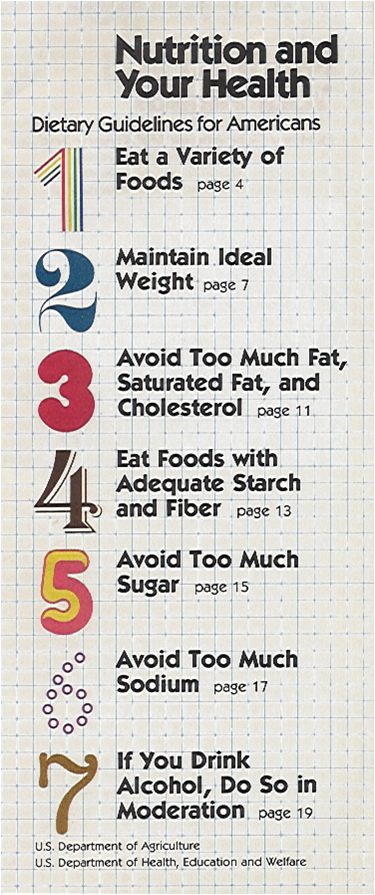
This year's report does not offer huge revelations in terms of overall nutrition. Check out the graphic on the right that I got from Marion Nestle's post.  These are the guidelines from 1980!  Not big shock that a lot of similar recommendations are in this years report. 

What is interesting is that some of the more subtle wording in recommendations might make some waves (my emphasis added):

  • "Shift food intake patterns to a more plant-based diet that emphasizes vegetables, cooked dry beans and peas, fruits, whole grains, nuts, and seeds."

  • "the goal [for sodium] should be 1,500 mg per day for the general population."

  • "Improve nutrition literacy and cooking skills, including safe food handling skills, and empower and motivate the population, especially families with children, to prepare and consume healthy foods at home."
Changing to a mostly plant-based diet, reducing sodium and improving cooking skills so that we can cook more meals at home would be a huge shift for this country.  As mentioned briefly in my previous post, we might need a food revolution to help reverse the current obesity epidemic. Well all three of these subtle changes, sound pretty revolutionary to me.  We are a nation of convenience especially when it comes to food.  We want the easiest, simplest, meals to eat.  We complain we don't have enough time to cook when in reality I think we just don't make it a priority.  

But let's be honest with ourselves.  How much change will these 2010 Dietary Guidelines really bring?  Just to give you a little Government 101, this report is from the Advisory Committee. The report is open for public comment from now until July 15th.  After July 15th,
.. [the] USDA and HHS will consider these and other comments as they translate the Advisory Report of the Committee into the 2010 Dietary Guidelines for Americans. Secretary Vilsack and Secretary Sebelius will release the 2010 Dietary Guidelines policy document jointly at the end of 2010.
In lay mans terms, the Dietary Guidelines are not set in stone yet.  There is going to be some changes so stay tuned!

Regardless of what changes are made to the final guidelines, it's clear to me that more and more people are understanding the importance to making real food at home. I think Michael Pollan says it quite well when he writes, "“Eat food. Mostly plants. Not too much.”

The questions remains, will this country do it?  I think we can! 

Thursday, June 3, 2010

Issues with the ADA

Spring is a time for renewal, and not just in the garden.  It is also the time of year when RDs are asked to renew our membership to the American Dietetic Association (ADA).  As many of my colleagues will attest, I have struggled with my membership to this organization recently. 

In comparison to other professional organizations, the ADA is relatively small. We don't have the power (aka money) compared to other food corporations and food lobbyists to meet our vision which according to the website is:
Optimize the nation's health through food and nutrition
Like any organization, ADA gets donations to help accomplish its goals. Go to the ADA Corporate Sponsors page here and you'll see for yourself who has been donating money to the ADA. The list includes companies like Unilever, Mars Inc, The Coca-Cola Company, General Mills, and PepsiCo to name a few.  So what's wrong with taking a few bucks from some corporate sponsors?

My issue is that some of these companies are a big reason why RDs are so busy these days.  Added sugar in cereals and beverages, highly processed foods and candy bars just some of the many reasons for the growing obesity epidemic in this country.  And like I highlighted in a previous post here, some of these companies are even trying to convince us that their high sugar foods are healthy choices! What message does it send to our community when as a profession we say, "Drink less soda, eat more high fiber/low sugar cereals and choose healthy snacks," but then the ADA takes contributions from the companies that profit from these same foods.  To me, it undermines our credibility and without credibility can we really accept the title of "nutrition experts"?

I follow Marion Nestle on Twitter and always find some interesting new tweets from her.  Last month this tweet popped up.  I followed the link to Michele Simon's blog Appetite for Profit.  Her post detailed how a RD from Canada, Sybil Hebert, had similar concerns with her professional organization, the Dietitians of Canada.   Ms. Hebert's original post is here.  In writing about the exact same moral dilemma she says,
How does this affect DC's [Dietitians of Canada] message? How does this make dietitians look? Do you think they can be unbiased and critique the food industry, if they're getting money from it? 
She wrote a great letter that she sent to the DC and I applaud her efforts! 

So where did that leave me as the June 1st deadline approached?  After a lot of thinking, I decided to renew my membership for another year.  A friend said, "Maybe you can make more change from within an organization rather than just dropping out?" So that is my personal challenge. I'm not going to be a silent observer.  I plan to write a similar letter to the ADA that Ms. Hebert wrote to the DC.   I'm going to make my voice heard for the next year and I encourage other RDs to do the same if they agree.

Wednesday, May 26, 2010

Extreme Eating

Every year the Center for Science in the Public Interest (CSPI) publishes a list of most extreme over-indulgent restaurant foods.  This year's list just came out yesterday and you can read it here.  As always, CSPI opens our eyes to even more high calorie, high salt and high fat gut busters from some of the nations most popular restaurants.

Each year they do this I am surprised by how truly "extreme" some of these meals are.  One item that shocked me were the burgers from Five Guys.  According to the article, the hamburger,"...700 calories (with no toppings) makes a Big Mac (540 calories) or a Quarter Pounder (410 calories) look like kids food. And the McDonald’s numbers include the burgers’ fixin’s. A Five Guys Bacon Cheeseburger has 920 calories and 30 grams of saturated fat (1½ days’ worth) without toppings. Think two Quarter Pounders."  It's not just the burger that was shocking but the fact a large fries will add an extra 1460 calories was just draw jopping.  

The other standout is the Double Pan Fried Noodle Combo from P.F. Chang's.  Sure the 1820 calorie dish is extreme but the most disgusting part is that the dish has 7690 gm of sodium.  Seriously?  Come on, that's nearly 3x the amount recommended for a healthy adult. 

Since reading and writing about The End of Overeating, I continue to think differently about eating out.  These foods have an affect on us.  We crave them and even though we are repulsed when we find out whats in them, they are on the menu for one simple reason, they sell!  Take the Double Down from KFC for example, we laugh about how gross it is but KFC just decided this week to continue selling the item because the demand was there.

CSPI's article is another reminder about how challenging eating out can be.  I'm sure they did not have a hard time finding "extreme" meals.  I bet the real problem was cutting down the choices to just nine that were described in the article.  We love the sensationalism of "extreme" eating but it's what we do with the information that is important.  We vote with our pocket books and if we stop buying 1800 calorie entrees the restaurants will stop selling them.  Menu labeling in restaurats is coming soon and let's hope that will help us make healthier choices rather than enjoying the shock of seeing something that is 1800 calories on the menu. 

Wednesday, May 19, 2010

The Power of the Pedometer

Any successful weight loss program has some physical activity component.  Exercise has many benefits including: helping burn calories, building muscle and reducing stress, to name a few.  From my experience, both personal and professional, exercise is one of the more difficult behavior changes to make.  For some reason it is a little easier to choose the salad or brown rice than it is to sweat and be active.

The key with any life-style change is to make it a part of your daily life.  If you like to play a sport, find a local gymnasium that might have an adult league you can join.  If you like to be outdoors, plan weekly hikes or walks.  The point is, think about your favorite activity and try to incorporate some exercise around it.

Maybe you're like me and you find that you like to set goals for yourself and like to set small challenges to motivate you.  That is where a simple tool like a pedometer can help.  A pedometer is a device you wear on your belt or waist and it counts your steps.  The goal is to try to walk 10,000 steps in one day.  How far is that you might ask?  That depends on your stride length but in general, 10,000 steps is usually 5 miles.

Do you have to walk 5 miles at one time?  No.  Getting 10,000 steps in a day requires you to be creative in how you spend your day.  Most people average 3,000-5,000 steps per day just in normal daily activities.  So let's assume you are on the low end of that range, you need to find another 7,000 steps to meet your goal.  Think about your day and when you can take a short walk.  Walking for 30 minutes at work might help you get 2,000 steps depending on your pace.  Go for a walk after dinner with your family instead of turning on the TV.

I am a firm believer in the power of the pedometer.  I got one from work and I wear it every day.  I look at it multiple times during my day to see how many steps I am at.  Do I get to 10,000 every day? No, but I do come close.  I love getting up from my desk, walking to the printer and knowing I just added another 125 steps to my total.  I know I'll get an additional 200 steps by taking the stairs instead of the elevator.  It all adds up.  The research shows that a simple $10 pedometer can help you increase your physical activity level and therefore help you manage your weight.

If you challenge yourself you will find ways to get those extra steps in your day.  Challenge yourself to be more active, especially if you want to help manage your weight.

Thursday, May 13, 2010

Our Champion for Change

I don't care how you feel about her husband or his politics, First Lady Michelle Obama is doing amazing work with respect to changing how this country eats.  Not only did she plant a garden on the White House lawn but she has now set her sights on fighting childhood obesity.  She doesn't want to just make a dent in the problem either, she wants to solve it, and within one generation.

In February, she launched the Let's Move campaign and soon after, President Obama appointed a task force to give recommendations on how to solve the problem of childhood obesity.  This week, that task force submitted their recommendations to the President.  You can read the brief summary here or the whole 124-page report here.

In short, the task force made recommendations within five major areas, early childhood, empowering parents and caregivers, healthier food choices in school, improving access to healthy foods and increasing physical activity.  Marion Nestle did a great job of summarizing some of the key recommendations on her recent blog post

Reading the recommendations I'm impressed with two things. First, this report mobilizes a group of federal and local agencies.  The problem of obesity is a complex problem with no simple answer.  Smartly, Obama knew that she needed the help of the FTC, USDA, DHHS, EPA and HUD (to name a few) to help solve the problem. 

Secondly, the report has recommendations in many different areas. The recommendations deal with everything from breastfeeding promotion, helping increase the availability of healthy foods in poor urban and rural areas, encouraging food companies to standardize nutrition labeling on the front of packaged food, helping schools upgrade their equipment to give them the availability to actually cook more food, and asking restaurants to decrease portions and improve children menus.

The truth is that there are many factors that have caused our nation's children to gain weight and it will require a broad, far-reaching change to find a solution.  It's been said we need a food revolution in this country.  Mrs. Obama and her Let's Move campaign just handed us the blueprint.  I am proud to have the First Lady as our champion for change and I'm behind her all the way!

Saturday, May 8, 2010

Cooking at Home

Huffingtonpost.com recently added a Food section to their site. One of the first articles was written by food writer Micheal Ruhlman. I’ll let you read the article here, but the basic gist of it was that we ALL have time to cook at home!


I’m the father of 2 1/2 year old twins and since my wife gets home from work later than I do, I’m responsible for making dinner for the family. We sit down and eat together as a family every night but I have to admit that I too cut corners and often complain, “I don’t have time to cook”, especially since the kids were born. Over the past few years we’ve resorted to more simple meals where we are heating food more than actually cooking it.


So there I am sitting at my desk, reading Mr. Ruhlman’s article and it dawned on me. ‘I do have time to cook.’ I remembered seeing a recent episode of No Reservations (a must watch show for any foodie) where Thomas Keller showed how to make his favorite recipe, roasted chicken. I found the recipe online at Epicurious.com and decided that THIS is what I was going to cook. Was it organic, farm-raised chicken? No! We are on a budget after all! But regardless, this simple roasted chicken which was served with quinoa and fresh corn was probably one of the best meals I’ve ever had and not only because it tasted great but because what happened during the meal. We got eat on the patio since the weather just started warming up. Sitting outside in the evening sun with my wife, watching our kids eat every morsel of food on their plate and licking their fingers with a smile was a priceless memory I will hold on to forever.


So take the time to cook. Make it a priority, even if it’s just once a week. Not only will you feel a great sense of accomplishment, but by cooking whole foods and choosing less processed or ready-prepared foods is a great way to start to limit your sodium intake. And who knows, you might create your own priceless memory.